
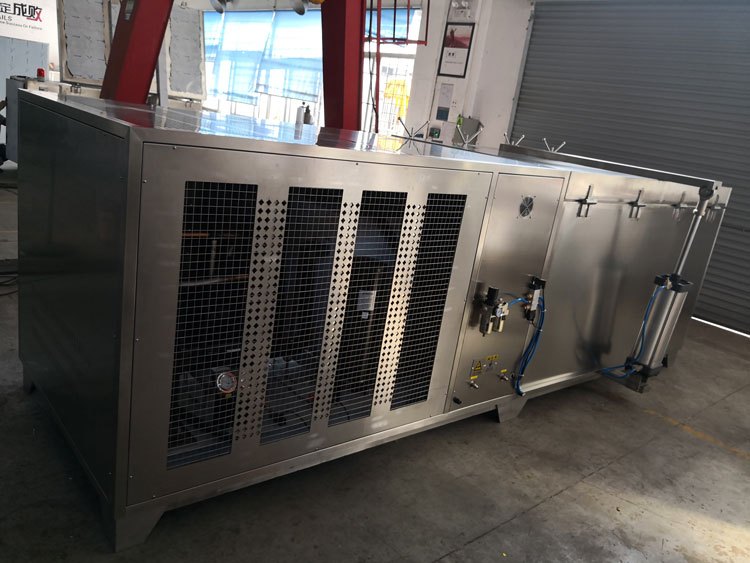
The requirement
A die and tooling shop treated its own dies after hardening and wanted to bring the process in-house. Loads were mixed: dies up to 400 kg, small inserts, and occasional batches of bearing components. The process specification called for -120°C with a controlled soak and return.
The configuration
| Item | Specification |
|---|---|
| Chamber | SLX-966 |
| Internal size | 900×600×600 mm |
| Capacity | 650 kg |
| Temperature range | Ambient to -120°C |
| Control accuracy | ±1°C |
| Uniformity | ±5°C |
Why a compressor chamber
The shop’s loads are irregular — a few dies one day, a batch of inserts the next. A liquid nitrogen chamber would cool faster, but the gas cost per cycle would be carried on every small load, and the shop did not want a gas supply contract for intermittent use.
The chamber size was set by the largest die plus clearance for air circulation, not by the total batch weight: stacking dies against each other creates a cold shadow and the centre of the stack never reaches the set point.
Process control
The cycle is stored as a program: ramp down over several hours, soak at temperature, controlled return. The controller logs each run, which gives the shop a record to hand to customers who ask for treatment documentation.
What to watch in operation
- Loading pattern — air has to circulate around every part.
- Door seal condition; a worn seal frosts and costs temperature uniformity.
- Sensor calibration on a scheduled interval; the ±1°C control is only as good as the sensor.
Reference configuration. Cycle times depend on load mass and material.
Request a configuration
The more you tell us about the product and the line, the more precise the proposal.