
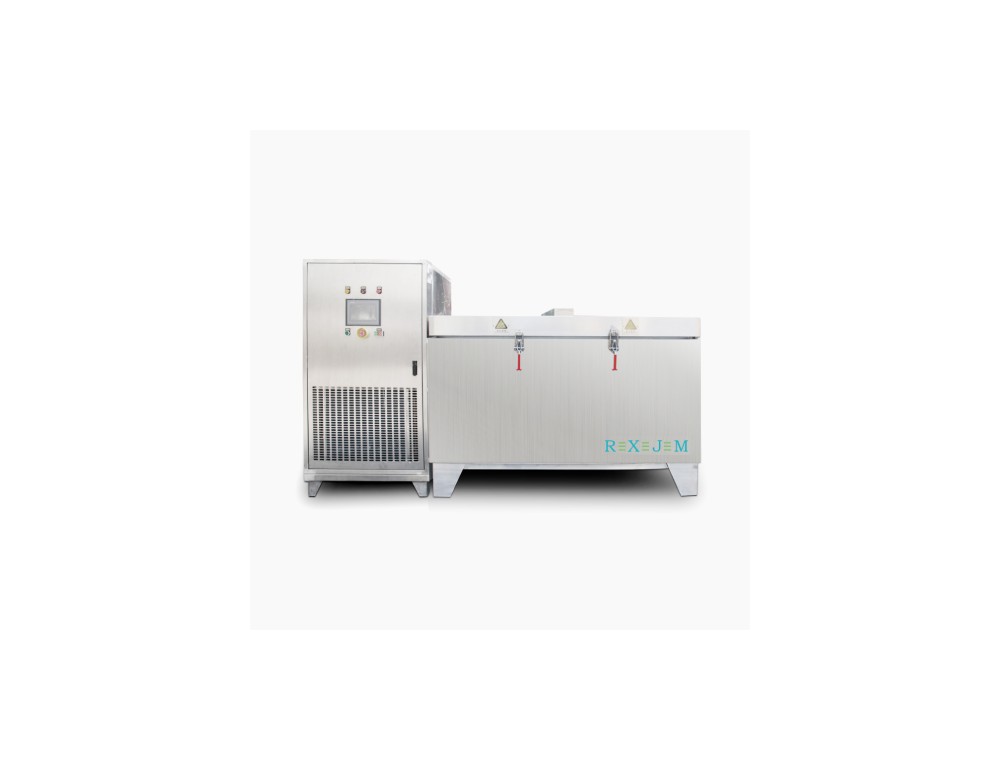
Overview
Cryogenic treatment holds metal parts at low temperature long enough for retained austenite to transform and for fine carbide precipitation to occur. The result is a change in the microstructure — harder surfaces, better wear resistance, less dimensional drift after machining — and it depends on the chamber holding a stable, uniform temperature for the full soak, not on how fast it gets there.
The SLX series uses a compressor cascade rather than liquid nitrogen. That removes the recurring gas cost and the delivery dependency, at the price of a lower minimum temperature: -120°C, which covers the great majority of tool steel, bearing and gear treatments.
Standard models
| Model | Internal chamber (L×W×D) | External (L×W×D) | Load capacity | Lead time |
|---|---|---|---|---|
| SLX-544 | 500×400×400 mm | 1,330×700×915 mm | 150 kg | 2–4 weeks |
| SLX-755 | 700×500×500 mm | 1,530×800×960 mm | 500 kg | 3–6 weeks |
| SLX-966 | 900×600×600 mm | 1,730×900×1,060 mm | 650 kg | 3–6 weeks |
| SLX-1077 | 1,000×700×700 mm | 1,830×1,000×1,160 mm | 1,000 kg | 4–6 weeks |
| SLX-1499 | 1,400×900×900 mm | 2,230×1,200×1,360 mm | 1,500 kg | 4–6 weeks |
Process data
| Parameter | Value |
|---|---|
| Temperature range | Ambient to -120°C |
| Control accuracy | ±1°C |
| Temperature uniformity | ±5°C |
| Chamber material | SUS304 inside and out |
| Insulation | 150–200 mm, BASF material |
| Door seal | Double seal, low-temperature grade |
| Refrigeration | Imported compressor, single-unit auto-cascade |
| Refrigerant | Fluorine-free blend |
| Ambient temperature | 10–40°C |
Design points
- Uniformity over speed. Circulating fans and a plenum distribute cold air across the load; the ±5°C figure is what makes a treatment repeatable between batches.
- No cold bridges. Insulation and door seal are detailed so the outer skin stays dry and the frame does not frost.
- Observation window. Vacuum glass window for checking the load without opening the chamber.
- Alarms and access control. High/low temperature alarms, sensor fault alarm and password protection on the program.
- Integration. The chamber can be placed inline with vacuum or multi-purpose furnaces for a continuous treatment route.
Applications
Tool and die steel, bearings, gears, cutting tools, fuel injection components, automotive parts, and dimensional stabilisation of precision components before final machining.
FAQ
-120°C or liquid nitrogen?
Liquid nitrogen reaches -196°C and cools faster, but the running cost per batch is higher and supply has to be managed. For most tool steel and bearing treatments, -120°C with a controlled soak gives the same metallurgical result at a lower operating cost. Where the process specification calls for -150°C or below, we supply an LN2 version instead.
How long is a treatment cycle?
It depends on load mass and the process specification, typically a controlled ramp down, a soak of several hours, and a controlled return to room temperature. The controller runs the whole profile unattended.
Can it be validated?
Yes. We can supply a temperature record from a test run with thermocouples placed in the load, and the controller logs every cycle for traceability.
Request a configuration
The more you tell us about the product and the line, the more precise the proposal.