
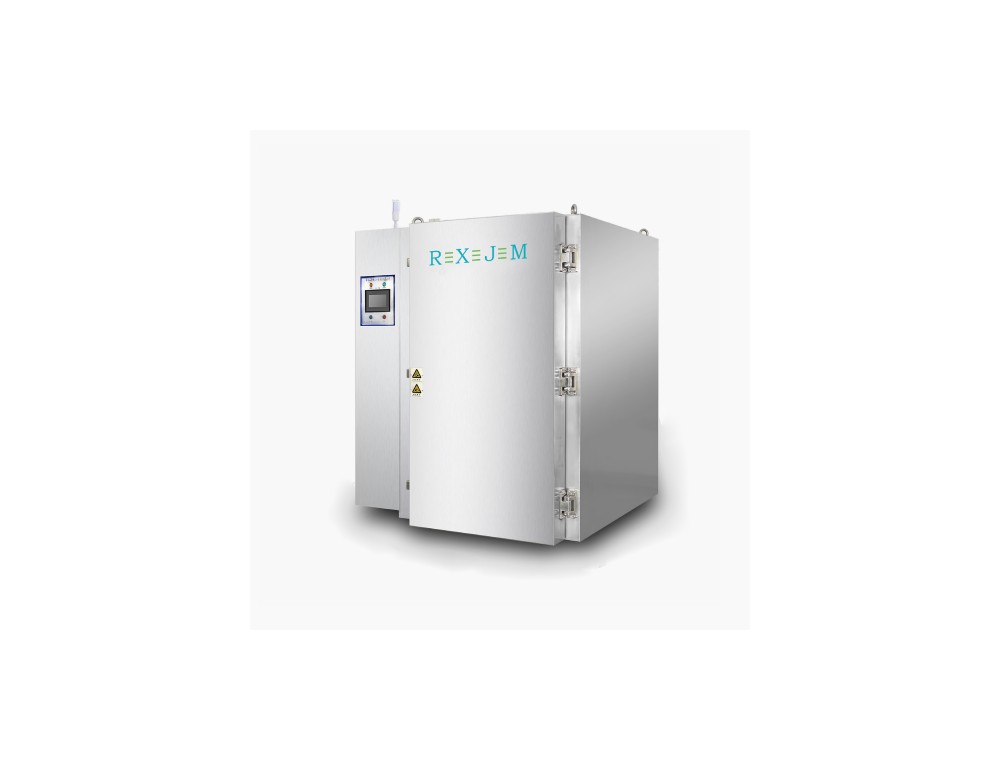
Overview
The cabinet freezer is the right machine when production is batch-based, when the product is packed in trays or boxes, or when a tunnel’s continuous flow does not match the line. Product is loaded on trolleys or racks, the door is sealed, and nitrogen is injected until the core reaches target.
Doors open on the front face, in single, double or four-door layouts. Four-door units allow one chamber to be loaded while another is in freezing, which keeps the operator working through the cycle instead of waiting for it.
Standard models
| Model | Internal chamber (W×D×H) | External (W×D×H) | Power | Capacity |
|---|---|---|---|---|
| DJL-QF-50A | 700×900×700 mm | 1,550×1,300×2,000 mm | 1 kW | 50 kg/h |
| DJL-QF-100A | 700×900×1,400 mm | 1,550×1,300×2,000 mm | 1.5 kW | 100 kg/h |
| DJL-QF-150A | 700×900×1,800 mm | 1,550×1,350×2,300 mm | 1.5 kW | 150 kg/h |
| DJL-QF-300A | 900×1,320×1,800 mm | 1,750×1,750×2,300 mm | 2.5 kW | 300 kg/h |
| DJL-QF-600A | 900×1,100×1,800 mm | 2,700×2,000×2,300 mm | 3.5 kW | 600 kg/h |
| DJL-QF-1200A | 1,170×1,500×1,800 mm | 3,800×2,000×2,300 mm | 7 kW | 1,200 kg/h |
| DJL-QF-2000A | 1,350×1,450×1,800 mm | 5,920×2,200×2,580 mm | 10 kW | 1,500 kg/h |
| DJL-QF-3000A | 1,350×1,700×1,800 mm | 5,920×2,420×2,580 mm | 10 kW | 2,000 kg/h |
Process data
| Parameter | Value |
|---|---|
| Refrigerant | Liquid nitrogen, 5–8 bar |
| Working temperature | Down to -120°C |
| Cycle time | 1–30 minutes, set per recipe |
| Body material | 304 stainless steel |
| Insulation | 150 mm polyurethane |
| Power supply | 380 V / 50 Hz (other voltages on request) |
| Loading | Trolleys, racks or trays |
Design points
- Door layout matched to the line. Single door for low volume, double for two trolleys, four-door where loading and freezing must overlap.
- Uniform airflow. Fans are positioned so cold vapour reaches the corners of the chamber, not just the centre — the difference shows up in core-temperature spread between trolleys.
- Low nitrogen loss. Door seals and a vapour return line reduce boil-off during loading, which is where most of the waste in a badly set-up cabinet occurs.
- Sanitation. Internal surfaces are smooth stainless with coved corners, and the drain is positioned for wash-down.
FAQ
Cabinet or tunnel?
If the product is packed, produced in batches, or the hourly output is below roughly 500 kg, a cabinet is usually the better investment. Above that, a tunnel’s continuous flow and cold-vapour recovery normally win on nitrogen consumption.
Can it freeze in trays?
Yes. Tray spacing and fan position are set at order so that air can pass between trays; stacking trays too tightly is the most common reason a cabinet underperforms in the field.
What is the lead time?
Standard models are typically 4–8 weeks from order confirmation, depending on chamber size and door configuration.
Request a configuration
The more you tell us about the product and the line, the more precise the proposal.