
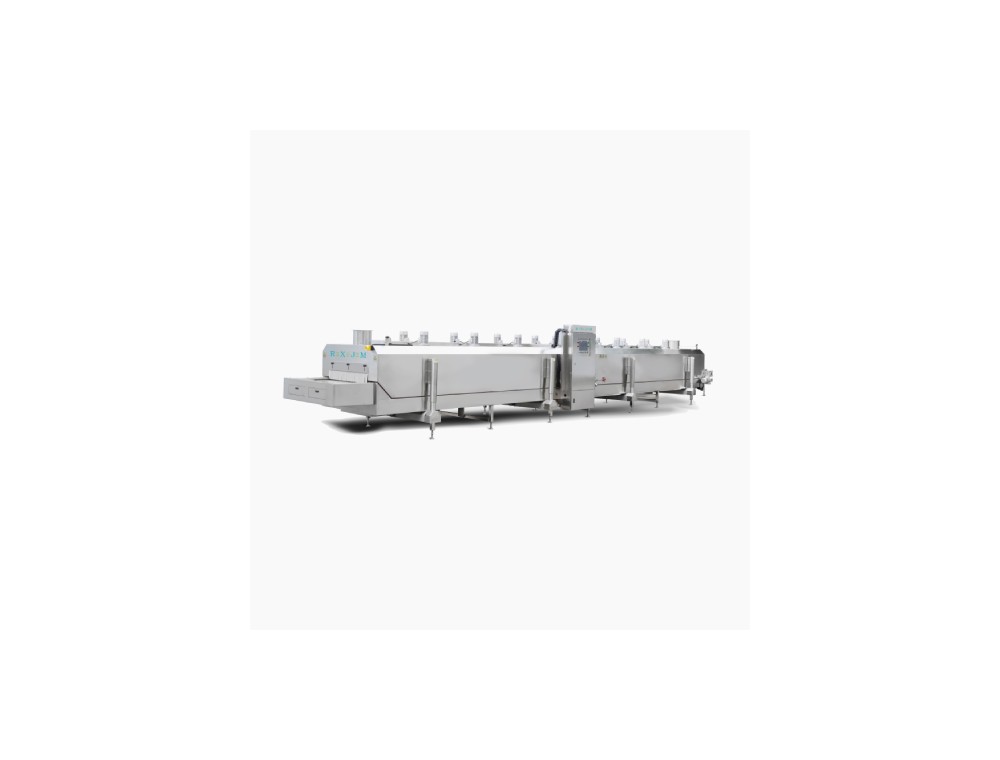
Overview
The tunnel freezer moves product through an insulated chamber on a stainless mesh belt while liquid nitrogen is injected and vaporised by circulating fans. Because the refrigerant enters at -196°C, the product surface passes the zone of maximum ice-crystal growth (0°C to -5°C) within minutes, which is where drip loss and cell damage are decided.
The chamber is built from modular stainless steel sections, with a screw lift on the top cover for cleaning and service access. Belt speed, nitrogen injection and fan speed are set from the touch screen and stored as recipes, so a shift change does not require re-tuning.
Standard models
| Model | Tunnel length | Belt width | Total power | Capacity |
|---|---|---|---|---|
| DJL-QFL1206 | 6,000 mm | 1,200 mm | 8 kW | 400–500 kg/h |
| DJL-QFL1209 | 9,000 mm | 1,200 mm | 12 kW | 600–800 kg/h |
| DJL-QFL1212 | 12,000 mm | 1,200 mm | 16 kW | 800–1,000 kg/h |
| DJL-QFL1609 | 9,000 mm | 1,600 mm | 16 kW | 800–1,000 kg/h |
| DJL-QFL1612 | 12,000 mm | 1,600 mm | 18 kW | 1,000–1,200 kg/h |
| DJL-QFL1615 | 15,000 mm | 1,600 mm | 20 kW | 1,400–1,600 kg/h |
| DJL-QFL1816 | 16,000 mm | 1,800 mm | 24 kW | 2,000–2,500 kg/h |
| DJL-QFL1818 | 18,000 mm | 1,800 mm | 24 kW | 2,250–2,750 kg/h |
| DJL-QFL2418 | 18,000 mm | 2,400 mm | 32 kW | 2,500–3,000 kg/h |
| DJL-QFL2436 | 36,000 mm | 2,400 mm | 64 kW | 5,000–6,000 kg/h |
Process data
| Parameter | Value |
|---|---|
| Refrigerant | Liquid nitrogen, 5–8 bar |
| Working temperature | Down to -120°C (nitrogen boils at -196°C) |
| Retention time | 1–30 minutes, adjustable |
| Body material | 304 stainless steel |
| Insulation | 150 mm polyurethane |
| Cover opening | Mechanical screw lift |
| Control | PLC + touch screen, recipe storage |
Where it fits
- Seafood: shrimp, fillets, whole fish, cephalopods — individually frozen or in trays
- Poultry and red meat: portions, wings, diced product
- Prepared food: dumplings, meatballs, patties, rice and noodle dishes
- Bakery: part-baked bread, pastry, dough pieces
Configuration notes
A tunnel is sized from three numbers: hourly output, belt load per square metre, and the dwell time the product needs to reach its target core temperature. Two lines with the same hourly output can need different tunnel lengths if one freezes 30 g shrimp and the other 200 g chicken breasts.
Where floor space is tight, we can supply a two-tier belt or a spiral configuration; where the product is packed in trays, the belt is fitted with guides and the injection is re-balanced across the belt width.
FAQ
What determines the nitrogen consumption?
Consumption follows the heat the product gives up: sensible heat down to freezing, latent heat of the water content, and the heat pulled out below freezing. A tunnel with good insulation and balanced injection recovers cold vapour from the exhaust to pre-cool incoming product; that recovery is what separates a well-tuned tunnel from one that simply burns more nitrogen.
Can the tunnel run at partial load?
Yes. Zones can be shut off independently and the belt speed reduced, but efficiency drops below roughly half load — at that point a cabinet freezer is usually the cheaper machine to run.
What is required on site?
A level floor, 380–415 V three-phase supply, liquid nitrogen storage with a vapour riser at 5–8 bar, and exhaust ventilation sized for the nitrogen boil-off. We provide the utility schedule with the layout drawing.
Request a configuration
The more you tell us about the product and the line, the more precise the proposal.