
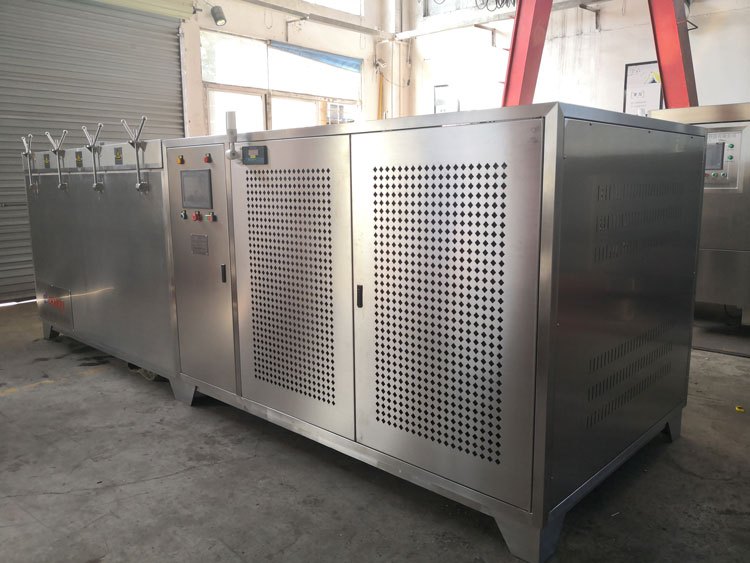
What the process does
Cryogenic treatment continues the martensitic transformation that stops at room temperature. Retained austenite converts, fine carbides precipitate, and residual stress redistributes. In practice the buyer sees harder surfaces, better wear resistance and less dimensional movement after machining.
The result depends on three things: reaching the specified temperature, holding it long enough for the whole load, and returning to room temperature under control. A chamber that cools quickly but unevenly gives a different result at the centre of the load than at the edge, and the difference only shows up in service.
Machine selection
| Load | Recommended chamber |
|---|---|
| Small tools, injection nozzles, up to 150 kg | SLX-544 |
| Dies, gears, mixed batches up to 500 kg | SLX-755 |
| Bearing rings, cutting tools up to 650 kg | SLX-966 |
| Automotive parts, larger dies up to 1,000 kg | SLX-1077 |
| Heavy tooling and batch production up to 1,500 kg | SLX-1499 |
Process profile
A typical cycle has four stages: controlled ramp down, soak at the treatment temperature, controlled return to room temperature, and in some specifications a tempering step afterwards. The ramp and soak times are set from load mass and material, and stored as a program so the same load gets the same cycle every time.
Where it fits in production
- Before final machining for dimensional stabilisation of precision parts
- After hardening for tool and die steel
- As a service line for heat-treatment shops serving several customers
- Inline with vacuum or multi-purpose furnaces where the chamber is loaded directly from the furnace route
What we need to size a chamber
- Maximum load mass and the largest single piece
- Material and the treatment specification (temperature and soak)
- Cycles per day and how the load is presented (basket, rack, stacked)
- Whether the chamber will run inline or as a stand-alone unit
Request a configuration
The more you tell us about the product and the line, the more precise the proposal.